Whole-Home Audio in Ottawa: How We Plan Music Room by Room

Most people walk into the showroom asking which speakers to buy. The speakers are the easy part. The planning is what decides if a whole-home audio system gets used every day or sits there with a dusty app on someone's phone.
Here is how we walk through it with homeowners.
Start with the rooms you actually use
Don't put speakers everywhere just because you can. Think about a normal week. Where is music on? For a lot of families it's the kitchen and the main living area. Then the deck in summer. Sometimes the primary bathroom, or the gym in the basement.
Each of those becomes a zone. A zone is an area that plays one source at one volume. If the kitchen and dining room are open to each other, they can share a zone. A bedroom should be on its own, so nobody wakes up to somebody else's playlist.
Write that list down before anything else. It drives the speaker count, the wiring and the amplifier choice.
Pick the speaker for the room
In kitchens and family rooms we usually go in the ceiling. The grilles are small, they can be painted, and they line up with the pot lights. Sonance Architectural Series speakers use Sonance's TRUFIG mounting, so the grille sits flush with the drywall instead of on top of it.
Some clients don't want to see a grille at all. Sonance Invisible Series speakers get covered in the same finish as the surrounding wall or ceiling, so there is nothing to see. That has to happen during construction or a renovation, because the drywall finishing is part of the install.
In a living room where the couch faces one wall, in-wall speakers on that wall can give you better stereo than two speakers overhead. In a powder room or a hallway, one speaker is often plenty.
Outside is its own topic. We covered it in our guide to outdoor speakers for Ottawa yards.
Wireless, wired, or both
Sonos is the simplest way to get music in more than one room. An Era 100 on a shelf in the office and a soundbar in the family room both show up in the same app. You can group them or play something different in each.
Ceiling and wall speakers are passive. They need an amplifier somewhere. There are two common ways we handle that.
One Sonos Amp per zone. Amp puts out 125 watts per channel into 8 ohms. Sonos rates it for two pairs of regular 8-ohm speakers wired in parallel, or three pairs of Sonos Architectural by Sonance speakers. Each Amp is one zone, so every speaker on it plays the same thing at the same volume. With the Sonos Architectural speakers, Amp also supports Trueplay tuning using an iPhone or iPad.
A central amplifier in a rack. In bigger homes with a lot of zones, every speaker wire runs back to one equipment location and a multi-channel amplifier drives the rooms from there. This is where a control system starts to make sense.
Either way, plan one spot where the wires land. In many Ottawa homes that's the basement mechanical room or a closet near the panel. Amplifiers make heat, so the spot needs some airflow. A sealed cabinet under the stairs is not a good home for them.
How people actually turn it on
The person who set up the system is happy with the app. Everyone else in the house wants a button.
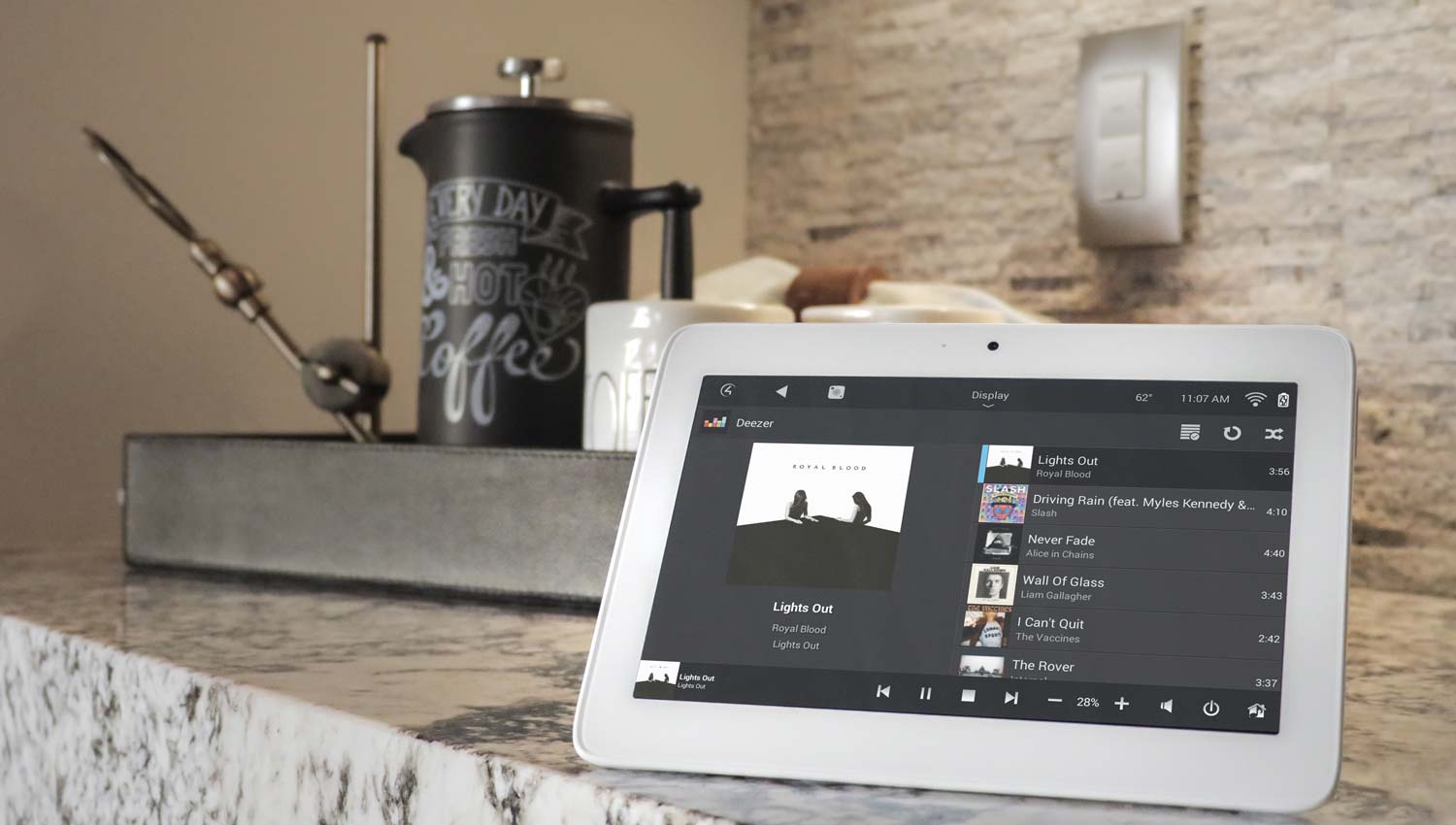
With Control4, a keypad by the kitchen door can start the morning playlist and set the volume. A touch screen on the counter shows what's playing in each zone. A goodnight button can shut every zone off on the way upstairs. Control4 also works with Alexa, Google Assistant and Josh.ai if you'd rather ask for the music.
You don't need Control4 to have whole-home audio. Plenty of systems run on Sonos alone. Control4 is worth it when you also want the lights and shades on the same buttons. Our smart home automation page shows what that looks like.
The network decides if it stays reliable
When music cuts out or a speaker drops off the app, the speaker is rarely the problem. It's usually the Wi-Fi. Sonos Amp has Ethernet ports, and when there's a cable available we use it. We also look at the access points before we hand anything over. If you want the long version, read why we start with the network or see our Wi-Fi and networking work.
When to plan it
The best time is before drywall. Wire is cheap when the walls are open. The ceiling cutouts go where you want them, not where the joists happen to allow.
Retrofits are possible too. Ceiling speakers under an attic or above an unfinished basement are usually straightforward. A main floor ceiling in a two-storey house takes more work. We'll tell you which rooms are easy and which ones aren't before you commit.
Come listen first
Speakers are hard to judge on a spec sheet. Our showroom at 1344 Youville Dr in Orléans has Sonos and Sonance set up so you can hear them in a real room. You can also browse what we carry in the Aura shop or read more about our audio and video work.
Call us at (613) 830-6787 or send us a note and bring your floor plan. We'll go through it room by room.
Frequently Asked Questions
What is a zone in a whole-home audio system?
A zone is an area that plays one source at one volume. Open spaces like a kitchen and dining room can share a zone. Bedrooms and offices are usually separate zones so each person can play their own music or nothing at all.
Can whole-home audio be added to an existing Ottawa home?
Yes. Ceiling speakers under an attic or above an unfinished basement are usually easy to add. Main floor ceilings in a two-storey home take more work. Wireless Sonos speakers can go in any room with power and a good Wi-Fi signal.
How many speakers can one Sonos Amp power?
Sonos rates Amp for two pairs of standard 8-ohm speakers wired in parallel, or three pairs of Sonos Architectural by Sonance speakers. All speakers on one Amp play the same source at the same volume.
Do I need Control4 for whole-home audio?
No. Many systems run on Sonos alone. Control4 makes sense when you want keypads and touch screens that also run the lights and shades.
Can I use speakers I already own with a Sonos Amp?
Often, yes. Sonos says the speakers should be rated for at least 125 watts at 8 ohms or 200 watts at 4 ohms, and nothing below 4 ohms. Bring the model numbers and we'll check them.
Where does the amplifier equipment go?
Usually in one central spot where all the speaker wires land, like a basement mechanical room or a ventilated closet. Amplifiers make heat, so they need airflow.
